




If you’re in a growth position, at some point over the past few months, someone has asked you what your plan is for GEO.
Most likely, the person who asked you doesn’t actually know what GEO is. Let’s say it’s a senior board member, so we’re all visualizing the same person, hearing the same intonation. They heard about it at an event, or maybe they saw people squabbling about it on the LinkedIn echo chamber, so now they know just enough to know it’s important, but not enough to speak to it with any level of confidence.
Which puts you in an interesting spot. Because maybe you don’t know either. Maybe you’ve told yourself you’ll dig into it when you have time.
Well, now you’re here. And I’ll guide you through it. After you read this, you’re going to sound super duper smart the next time you’re asked about GEO.
What is GEO?
Definitionally, Generative Engine Optimization (GEO) is the practice of optimizing your content and digital presence so that AI-powered search engines (ChatGPT, Perplexity, Google’s AI Overviews) surface, cite and synthesize your brand when generating responses to user queries.
In human speak, GEO is SEO for AI tools.
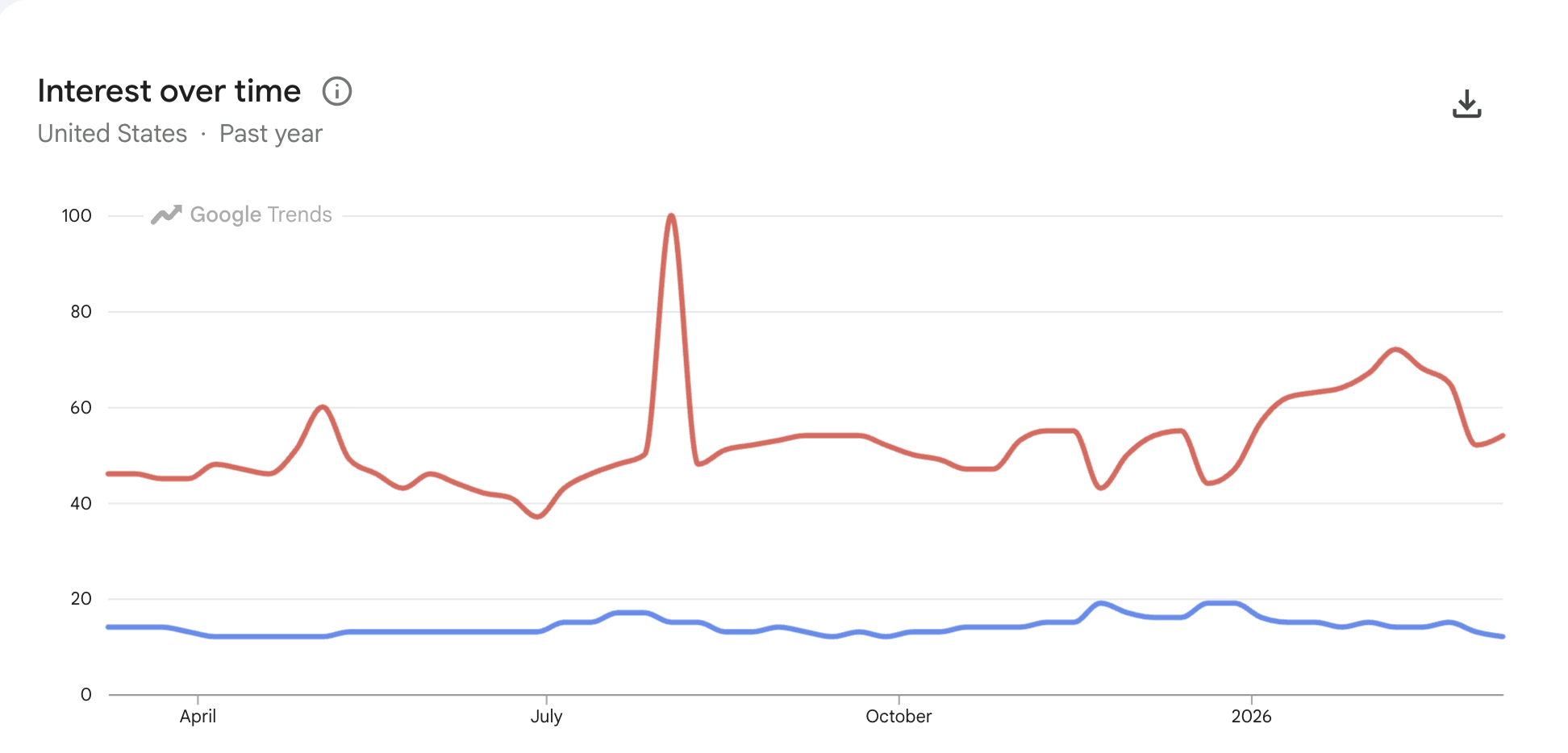
It’s possible you’ve heard the term AIO (Artificial Intelligence Optimization), which is the same thing as GEO. Neither are creatively named, but the consensus seems to be that GEO is what we’re going with. As you see in the Google Trends report below, GEO (shown in red) has won the title.
Whereas SEO earns you a position in a ranked list of links, GEO earns you a mention inside the actual answer a person reads within their AI tool of choice.
Instead of a blue underline or a click of a link, your brand is woven into the response as a credible source, or not woven in at all. A growing number of organizations are in the second category and haven’t figured that out yet.
Where Did GEO Come From?
GEO didn’t emerge from a clever agency rebrand or a LinkedIn thought leader in need of content. It emerged from a real and disorienting gap that SEO practitioners began to notice as AI search tools matured and spread.
As ChatGPT, Perplexity, and Google’s generative features began handling a serious volume of informational queries, marketers and SEOs found themselves confronting an uncomfortable reality: strong organic rankings weren’t translating into visibility in AI-generated responses.
A brand could hold a dominant position on page one of Google for a competitive keyword and still be completely absent from the AI answer a prospective customer received about that same category. The usual playbook wasn’t covering the new field.
Researchers at Princeton, Georgia Tech, and IIT Delhi were among the first to formalize what practitioners were already sensing in the field, publishing rigorous academic work that coined the term and began mapping the specific content signals that influence AI citation behavior. The terminology stuck, outlasting the aforementioned AIO, and the practitioner community organized around it, and GEO has been developing as a distinct discipline ever since.
GEO vs. SEO: What’s the Difference?
SEO and GEO share enough surface-level vocabulary that it’s easy to assume they’re the same mannequin, simply sporting different fits. While they’re related disciplines, they possess meaningfully different mechanics, objectives, and success metrics.
SEO optimizes for ranking algorithms that evaluate pages and return an ordered list of results. The user sees that list and decides where to click. GEO optimizes for generative AI systems that read across many sources, synthesize a response, and hand the user an answer. The user reads that answer, often without visiting any website at all. In SEO, winning means a position. In GEO, winning means inclusion in the output.
| SEO | GEO | |
| Goal | Rank in search results and increase organic traffic | Be cited in AI responses |
| Primary signals | Backlinks, keywords, technical health | Authority, clarity, entity recognition |
| Output | A ranked link | A synthesized answer |
| User behavior | User clicks a result, proceeds to website | User reads the AI response |
| Key asset | Optimized page | Trusted, citable content |
The practical takeaway is that strategic SEO remains a worthwhile investment and builds real infrastructure that GEO strategy can extend. But organizations treating these disciplines as interchangeable are optimizing for a version of search that handles a shrinking share of the queries that matter most.
Getting back to my hypothetical in the introduction, whoever asked you about GEO is right. You need to have a plan, and that plan cannot be a carbon copy of your SEO strategy.
How Generative Engines Work
Generative AI search tools are trained on vast heaps of text scraped from across the internet. Through that training, they develop a dense web of associations between concepts, entities, claims, and sources. When a user submits a query, the model draws on those learned associations and, increasingly, on live retrieval from current web sources, to synthesize a coherent and authoritative-sounding response. This is why, instead of a list, a user gets an answer.
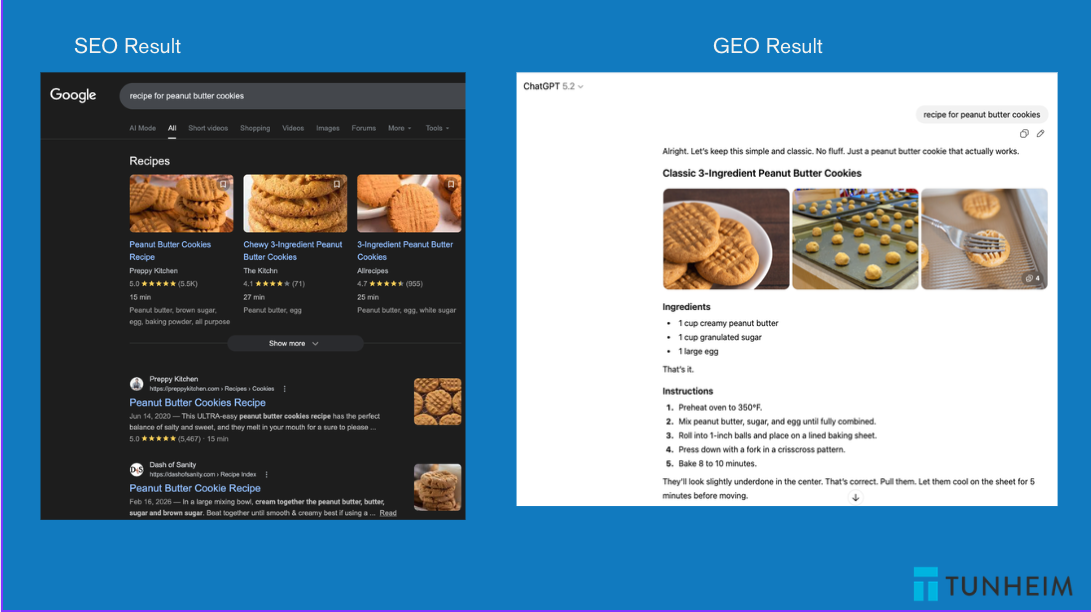
Take a look at the image above. The same search, one on Google. The other on ChatGPT.
Now here comes the somewhat frustrating part. What determines whose content gets pulled into that answer? We don’t know for certain.
AI tools are less forthcoming with their, for lack of a better phrase, ranking factors than search engines like Google and Yahoo are.
We do know that a combination of impact, answer structure, authority, and citation density is preferred by the tools. However, that knowledge has been gleaned largely by researchers, and not from the engineers of the tools themselves.
This is a marked difference from SEO where Google engineers would regularly provide guidance to SEO practitioners.
Why GEO Matters Right Now
ChatGPT crossed 100 million users faster than any consumer product in recorded history, reaching that milestone in two months. Instagram needed two and a half years. It took Gmail over 5 years. The growth curve of AI search adoption is truly unprecedented. It is, at once, tremendously exciting and horrifying.
A large and growing share of informational queries, the kind that move prospective customers through awareness and into consideration, are now being answered directly by AI tools. Users get a synthesized response and often go no further.
That means a company can maintain a strong, carefully tended organic search presence and still be invisible to a meaningful portion of the audience that matters most to them, simply because their content isn’t being surfaced in AI-generated answers. Scary!
AI tools develop persistent associations between brands and categories over time, as citations reinforce familiarity, which in turn drives further citations. Getting into those patterns early, before a category’s default sources are calcified, is a genuinely time-sensitive advantage – much in the same way that organizations that adopted SEO early still dominate rankings today.
How to Optimize for GEO
Now you know what GEO is. You have a basic understanding of how it works and how it differs from SEO. You know why it’s important. Now lets get into actionable steps you can take.
1. Start by auditing your existing content for citability
Pull up your highest-value pages and read them with a specific question in mind: does this page make a clear, quotable claim, and is that claim findable within the first two paragraphs? Pages that bury their value proposition under extended setup are the first candidates for revision.
2. Map your content to the questions your audience is actually asking AI tools.
AnswerThePublic, Reddit threads in relevant communities, and direct customer research are all useful here. The goal is to understand the specific, conversational questions your audience is typing into ChatGPT and Perplexity, then build content that answers those questions with genuine depth and specificity.
Another tool is Trakkr, which provides you with some insight into how you’re currently showing up in AI tools.
3. Establish named, credentialed authorship across your content.
Every substantive piece should carry a named author whose expertise is verifiable and documented externally, on LinkedIn, in published bylines, in speaking appearances, and in press coverage. AI systems factor author authority into citation decisions, and anonymous or generic corporate content loses that signal entirely.
Actively build your off-site footprint. Pitch bylines to credible trade publications and legacy media. Pursue earned media coverage that mentions your organization and your people by name. Seek out podcast appearances, speaking engagements, and partnership content that generate third-party references to your brand. The goal is a diverse, credible web of external mentions that corroborates your own content.
Build an AI presence monitoring practice. Run your most important queries in ChatGPT, Perplexity, and Google AI Overviews on a regular schedule. Track when your brand is cited, when it isn’t, and which competitors are appearing in your place. Without this feedback loop, you have no way to know whether your investments are working.
Who Needs to Care About GEO
Is GEO relevant to your organization? Most agencies will tell you YES! But in reality, it’s not as important to some organizations as it is to others. It all depends on your buyers’ activity.
The single most useful question to ask is: Does my buyer use search, or something that behaves like search, to research before they make a decision? If the answer is yes, GEO deserves serious attention. If the answer is no or sometimes, it should sit lower on the priority list than the people trying to sell you GEO retainers would prefer.
Organizations that should prioritize GEO now:
Professional services firms, B2B software, and SaaS companies must have a GEO plan. Their prospective buyers shop for their solutions in a comparative manner. Being cited as a credible voice in your category before a buyer ever hits your website is a real and meaningful advantage.
Consumer brands in considered-purchase categories (home improvement, financial products, health and wellness, insurance, higher education) also have strong GEO incentives. These are purchases where buyers spend real time gathering information, and AI tools are increasingly where that process starts.
Content-driven media organizations and publishers have an obvious stake. Being cited is, in many ways, the new being read.
Organizations where GEO is a lower priority:
Local service businesses with hyperlocal demand (plumbers, dentists, dry cleaners) operate in a world where Google Maps and direct referrals still dominate discovery. GEO is unlikely to move the needle for them in the near term.
Businesses driven almost entirely by word-of-mouth and relationship sales, certain enterprise deals, niche professional networks, and family-owned distributors have buyer journeys that don’t run through search of any kind. No amount of AI citation optimization changes that.
Commodity e-commerce competing on price and speed is also a weak fit. When the decision is “who has this item cheapest and fastest,” the buyer isn’t consulting an AI for a synthesized answer about brand authority. They’re checking price and shipping timeline.
The underlying logic is consistent: GEO is valuable in direct proportion to how much your buyer’s decision-making process involves open-ended research. The more research-dependent the journey, the higher the return on getting in front of it.
Go Sound Smart
You now know what GEO is, where it came from, how it works, and what to do about it. That is more than most people in your building can say.
When the board member asks again, you won’t be nodding along, hoping the conversation ends. You’ll have something real to say.
Tunheim works with organizations just like yours. If you want to talk through what a GEO strategy looks like for your brand, let’s get into it.